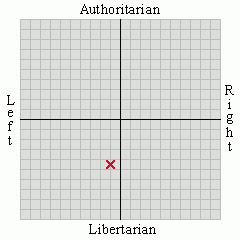
The state exists first and foremost, to ensure the safety of its citizens
This is probably where I am most conservative. As uncomfortable as something like the monstrous data center in Utah makes me from an ideological standpoint, I can't help but feel that this is a natural evolution of the world we live in. Threats to national security don't exist in back rooms and alleyways anymore. They exist in text messages, forums, and e-mails. If we don't allow the government to patrol our digital lives, then we are providing asylum to evil in the most powerful arena the world has ever known.
There is a dark value proposition that comes along with a free society and it goes like this: every step you take towards more personal freedom is another step that makes it easier for small groups or individuals to wreak havoc. Ben Franklin's famous quote ”He who would trade liberty for some temporary security, deserves neither liberty nor security” doesn't apply to modern society (and frankly, is a gigantic load of shit in the first place). Tyranny is a terrible thing, but government is not the only source of it. And it is the state's job to protect us from all forms of tyranny. This is the central role behind the state's existence, and in order to prevent widespread chaos, we have to give up some measure of our personal freedom.
Now, effective surveillance and ubiquitous surveillance are not the same thing (even if many of our politicians will try to convince you otherwise). The most unsettling part of the documents released in this Edward Snowden saga is the word "all" when it comes to the government's collection of our data. The 4th Amendment is partially outdated (as is much of our constitution), but probable cause is still an important part of any democracy. The government should not be able to just pop in and out of digital conversations to see if any wrongdoing is taking place.
What we also must understand is that the military and our national security apparatus is only one way to protect us from harm (albeit major ones). Programs like the EPA fall under the national security umbrella too. If we let the private sector do whatever it wanted, we would end up hurting thousands or perhaps millions of our own citizens. Safety and profit are not always compatible, and this is where the government must prioritize the health and wellness of its citizens over the profits of corporations.
A threat is a threat, regardless of its source. Our government and civil society is engineered to protect the people who support it. If the state fails at this task, then there is no state.
There is a dark value proposition that comes along with a free society and it goes like this: every step you take towards more personal freedom is another step that makes it easier for small groups or individuals to wreak havoc. Ben Franklin's famous quote ”He who would trade liberty for some temporary security, deserves neither liberty nor security” doesn't apply to modern society (and frankly, is a gigantic load of shit in the first place). Tyranny is a terrible thing, but government is not the only source of it. And it is the state's job to protect us from all forms of tyranny. This is the central role behind the state's existence, and in order to prevent widespread chaos, we have to give up some measure of our personal freedom.
Now, effective surveillance and ubiquitous surveillance are not the same thing (even if many of our politicians will try to convince you otherwise). The most unsettling part of the documents released in this Edward Snowden saga is the word "all" when it comes to the government's collection of our data. The 4th Amendment is partially outdated (as is much of our constitution), but probable cause is still an important part of any democracy. The government should not be able to just pop in and out of digital conversations to see if any wrongdoing is taking place.
What we also must understand is that the military and our national security apparatus is only one way to protect us from harm (albeit major ones). Programs like the EPA fall under the national security umbrella too. If we let the private sector do whatever it wanted, we would end up hurting thousands or perhaps millions of our own citizens. Safety and profit are not always compatible, and this is where the government must prioritize the health and wellness of its citizens over the profits of corporations.
A threat is a threat, regardless of its source. Our government and civil society is engineered to protect the people who support it. If the state fails at this task, then there is no state.
No one should have to choose between, food, housing, and medicine
If we are truly a nation of equals, then my life is no more important than yours or the homeless guy down the street. Lower food prices and affordable housing should be higher on our list of national priorities, but health care is the real driver of insanity in this country and must be fixed immediately.
 |
| (Click to enlarge) |
 |
| (Click to enlarge) |
Everyone should be covered. Period. Not only is our current practice morally bankrupt, it's economically insane. Medical bills are the number one cause of bankruptcy, and 10 million people with insurance will accumulate bills they can't pay off this year. It is indisputable that the main purpose of our healthcare system is to enrich those who profit off of treating pain and sickness. If it wasn't, then we wouldn't spend more than anyone with less results. This is a dystopian nightmare straight out of Europe in the 1930's. For those who say that healthcare is something that should solely be left to the free market like it is right now, I have four points I'd like to make:
- It's a terrible idea (where do you think the words "preexisting condition" came from?).
- Our insurance market isn't a normal market. It's an oligopoly.
- Monopolies and oligopolies are anti-capitalist.
- Your "free market" argument is the very definition of irony.
And there's plenty of evidence that the state can provide health care at a lower cost than the private sector. Our health care debate demonstrates the absurdity of favoring ideology over pragmatism. The United States WILL go broke if health care costs continue to rise at their current pace. Every option should be on the table to bring prices down, regardless of what ideological camp it may or may not fall in to. At the very least, we need to divert course from our current, immoral system because any country that prioritizes profit over the well-being of its citizens cannot call itself the greatest nation in the world.
If the middle class is in good shape, the economy is in good shape
In economics, the Multiplier Effect is defined as
The expansion of a country's money supply that results from banks being able to lend. The size of the multiplier effect depends on the percentage of deposits that banks are required to hold as reserves. In other words, it is money used to create more money and is calculated by dividing total bank deposits by the reserve requirement.
The multiplier effect really impacts almost any exchange of money. In short, my spending is your income (TM Paul Krugman, but it's also the best argument I've ever heard for the power of the private sector; the GOP would be wise to steal it).
Lending -->Jobs-->Innovation-->Wealth-->Repeat. That's the basic premise of the American economy. And all it's done is create more wealth than any economic system in the history of mankind.
When capitalism is captained by responsible drivers, it is a beautiful sight to behold. But when it's running around town with a briefcase filled with cocaine, the sight is unsettling. And yes, I am comparing our current economy to a Charlie Sheen bender. How else can you explain these charts? (Well, I guess you can argue that the upper 1% have become that much more valuable and productive than the bottom 99%, but if you believe that, well...you're not fit to be a human being, or you're Lloyd Blankfein)

Many of the arguments that you hear today about "sticking to free market principles" (mostly through deregulation) are contrary to the compromise at the heart of the system:
On a level playing field, the consumer will make the best and most efficient choice, and this benefits the rest of society when you factor in the exponential forces of the market. Much of the time, deregulation benefits entrenched interests by avoiding the creative destruction of capitalism. How can the consumer make the best choice for themselves if they are not presented with the entire array of products and services? Fixing our economy starts with breaking the political ties that have benefited so few for too long. And there's one clear place to start.
Much of our current malaise can be traced back to the sickness that infected Wall Street in the 1980's (the rise of debt as a prime asset). Deregulation and a perverse incentive structure (billions at Goldman Sachs or 5 figures per year at the SEC? Which would you choose? And if you choose the SEC, you can be bought off with half of a Christmas bonus) have lead to a system where many C level executives make decisions that are contrary to the interests of their clients, the people who work beneath them, and the rest of the country.
Big banks have a central importance to the economy, but stories like this prove that large parts of Wall Street have completely gone off the rails, and our political system has decided that billion dollar financial fraud is not a prosecutable offense. Strong oversight, and outright bans of new inventions like Off Balance Sheet Accounting, Collateralized Debt Obligations, and High Frequency Trading is necessary improve the efficiency and trustworthiness of some of our most important economic institutions.
While this sector has seen very little regulation, another is drowning in it.
Small businesses help to enrich our communities on levels that are unmeasurable by any economic model. Over the past decade they have been slammed by the 2008 crisis, the effects of low labor costs overseas, massive amounts of over-regulation, deregulation that benefits their larger competitors, and a new health care law that incentivizes them to not hire new workers. I have a simple idea that could help businesses across the country in an instant: stop putting the burden on them to provide healthcare. Tying healthcare to a job is immoral AND it's terrible economics! Think of how much capital we could free up if we removed this unnecessary de facto requirement on businesses everywhere (although Obama seems determined to remove "de facto" from that phrase).
Lastly, we must unburden those who buy things. The problem behind our slow economic growth is simple: consumption is what drives our economy (most estimates have it somewhere around 70%), but disposable income is tight because we are still dealing with the after-effects of a major debt crisis. The bust of the housing market is at the center of this because many Americans now owe more on their homes than they are worth, and spend what little capital they have on paying down their mortgages. The best solution would be a partial debt forgiveness program by the banks and the U.S. government (yes, this would cost a ton of money, but I know for a fact that many executives who went bust on housing debt in 2008 have made their money back plus a handsome profit. At some point, you have a moral obligation to the economic system that has ensured that you and your extended family will never want for anything ever again).
The bottom line is that our economy is somehow simultaneously over-taxed (small businesses), under-taxed (businesses with armies of accountants), over-regulated (small business again), and under-regulated (big business again, notice a theme here?). This isn't capitalism, it's special favoritism that has sucked the wealth from the middle class and transferred it to the 1%.
We've done nothing but heap crap on top of crap for over a century. It's time to go in there and clean the gunk out of our tax, legal, and regulatory system and replace it with one that is
The expansion of a country's money supply that results from banks being able to lend. The size of the multiplier effect depends on the percentage of deposits that banks are required to hold as reserves. In other words, it is money used to create more money and is calculated by dividing total bank deposits by the reserve requirement.
The multiplier effect really impacts almost any exchange of money. In short, my spending is your income (TM Paul Krugman, but it's also the best argument I've ever heard for the power of the private sector; the GOP would be wise to steal it).
Lending -->Jobs-->Innovation-->Wealth-->Repeat. That's the basic premise of the American economy. And all it's done is create more wealth than any economic system in the history of mankind.
When capitalism is captained by responsible drivers, it is a beautiful sight to behold. But when it's running around town with a briefcase filled with cocaine, the sight is unsettling. And yes, I am comparing our current economy to a Charlie Sheen bender. How else can you explain these charts? (Well, I guess you can argue that the upper 1% have become that much more valuable and productive than the bottom 99%, but if you believe that, well...you're not fit to be a human being, or you're Lloyd Blankfein)

 |
| (Click to enlarge) |
On a level playing field, the consumer will make the best and most efficient choice, and this benefits the rest of society when you factor in the exponential forces of the market. Much of the time, deregulation benefits entrenched interests by avoiding the creative destruction of capitalism. How can the consumer make the best choice for themselves if they are not presented with the entire array of products and services? Fixing our economy starts with breaking the political ties that have benefited so few for too long. And there's one clear place to start.
Much of our current malaise can be traced back to the sickness that infected Wall Street in the 1980's (the rise of debt as a prime asset). Deregulation and a perverse incentive structure (billions at Goldman Sachs or 5 figures per year at the SEC? Which would you choose? And if you choose the SEC, you can be bought off with half of a Christmas bonus) have lead to a system where many C level executives make decisions that are contrary to the interests of their clients, the people who work beneath them, and the rest of the country.
Big banks have a central importance to the economy, but stories like this prove that large parts of Wall Street have completely gone off the rails, and our political system has decided that billion dollar financial fraud is not a prosecutable offense. Strong oversight, and outright bans of new inventions like Off Balance Sheet Accounting, Collateralized Debt Obligations, and High Frequency Trading is necessary improve the efficiency and trustworthiness of some of our most important economic institutions.
While this sector has seen very little regulation, another is drowning in it.
Small businesses help to enrich our communities on levels that are unmeasurable by any economic model. Over the past decade they have been slammed by the 2008 crisis, the effects of low labor costs overseas, massive amounts of over-regulation, deregulation that benefits their larger competitors, and a new health care law that incentivizes them to not hire new workers. I have a simple idea that could help businesses across the country in an instant: stop putting the burden on them to provide healthcare. Tying healthcare to a job is immoral AND it's terrible economics! Think of how much capital we could free up if we removed this unnecessary de facto requirement on businesses everywhere (although Obama seems determined to remove "de facto" from that phrase).
Lastly, we must unburden those who buy things. The problem behind our slow economic growth is simple: consumption is what drives our economy (most estimates have it somewhere around 70%), but disposable income is tight because we are still dealing with the after-effects of a major debt crisis. The bust of the housing market is at the center of this because many Americans now owe more on their homes than they are worth, and spend what little capital they have on paying down their mortgages. The best solution would be a partial debt forgiveness program by the banks and the U.S. government (yes, this would cost a ton of money, but I know for a fact that many executives who went bust on housing debt in 2008 have made their money back plus a handsome profit. At some point, you have a moral obligation to the economic system that has ensured that you and your extended family will never want for anything ever again).
The bottom line is that our economy is somehow simultaneously over-taxed (small businesses), under-taxed (businesses with armies of accountants), over-regulated (small business again), and under-regulated (big business again, notice a theme here?). This isn't capitalism, it's special favoritism that has sucked the wealth from the middle class and transferred it to the 1%.
We've done nothing but heap crap on top of crap for over a century. It's time to go in there and clean the gunk out of our tax, legal, and regulatory system and replace it with one that is
- Simple to understand and follow
- Fair (meaning the little guy gets breaks at the expense of the titans)
- Properly incentivized according to one's level of risk
A good education is the best way to empower someone
Or in more practical terms
 |
| (Click to enlarge) |
Plus, our students aren't doing themselves any favors. The chart above is most definitely related to this one below.

This leads to a situation where kids leave college with more debt than they can handle, while plenty of good jobs remain available because of the lack of people with STEM majors. According to the article I linked to above:
Mathematics and engineering have a 6.0 percent and 7.5 percent unemployment rate, respectively. The average starting pay for mathematics majors is $46,000, while an engineering major can make $55,000.
 |
| Even if it may lead to you making 1/3 less than some of your peers |
We need to push more of our students towards the STEM majors. Advances in science, technology, transportation, and communication are how societies take great leaps forward, and a STEM major puts you in contention for jobs in every one of these sectors. Secondly, we need to dramatically reduce student debt because it is creating a massive drag on our economy and limiting our upside as a nation. Young people are supposed to be flexible in their career search, but when you're overburdened with bills every month, that makes it difficult to take any risks, even if they might have a big payoff (for example, I have a friend who will have paid 90% of the principal on their student loans in interest payments when it's all said and done. They can't leave their current job unless they can maintain their salary, otherwise, they'll go broke, and they're barely getting by right now).
There are two steps that the federal government can take to fix these issues. First, your debt payments should be fixed as a percentage of your income. This way, everyone can benefit from college and not have to worry about taking a particular job just so they can pay off their student loans. Secondly, we should follow the German model and create more specialized trade schools. This will spawn legions of technically capable individuals across the country, taking jobs that badly needed to be filled.
Our current education system is a picture of a nation begging to get its ass kicked in 50 years, we need to rethink how we teach our kids to compete in the new global economy before it's too late.
One man's liberty cannot be another man's poison
We all have a right to live happy, fulfilling lives. Our government centers around the philosophy that empowering individuals and private entities is the key to creating shared prosperity. But liberty does not mean that you can do whatever the hell you want (a point that far too many Republicans have forgotten). The constitution is a contract between all citizens. We have a shared responsibility to each other; even the people we hate.
Simply branding regulation as inherently bad or good misses the point entirely. We must enact intelligent legislation that does not over burden private enterprise, while still protecting the rights of individuals who would become collateral damage if it were not in place. This is what distresses me about our current political discourse; the arguments center around big versus small when it should be smart versus stupid.
We see this in the gun debate too. A small minority has taken control of our Congress with the argument that their "liberty" to own an arsenal trumps one's liberty of being able to walk into a school or a movie theater without being shot. Life is full of value propositions and trade-offs, and the safety of our public spaces trumps most "personal liberty" arguments. Open societies are based on trust, and if we cannot entrust our safety to strangers, then our society will cease to be open.
We see this in the gun debate too. A small minority has taken control of our Congress with the argument that their "liberty" to own an arsenal trumps one's liberty of being able to walk into a school or a movie theater without being shot. Life is full of value propositions and trade-offs, and the safety of our public spaces trumps most "personal liberty" arguments. Open societies are based on trust, and if we cannot entrust our safety to strangers, then our society will cease to be open.
Mixing money and politics will ALWAYS lead to corruption

Power has a way of accumulating funds; nobody writes a check without expecting something in return. Our last two presidential elections have seen over 11 billion dollars enter the political fray. That's a lot of favors. Lobbyists are an essential ingredient to democracy because different factions need to be represented properly, but when you throw that kind of cash into the equation, people are bound to start taking advantage of the system.
GE didn't pay any taxes on $14 billion in revenue in 2010. And they did so "legally." I put that word in quotes because while it does follow the rules and loopholes in our tax code, I'm guessing that those loopholes exist partly due to the fact that GE has spent $284 million lobbying since 1990. The world "legal" is a stretch. I look at figures like that and the ones below and see nothing but crony capitalism.
 | ||
| (click to enlarge) |
This is where I am probably most liberal. I believe that the only way to fix this massive problem is to have publicly funded elections; any half measures to reduce the amount of money entering the system will only be rolled back down the road. After doing some crude math (($5.8 billion/182,522,000 tax returns)/4 years)), I've determined that it would cost each of us $7.94 per year to fund the equivalent of the 2012 election every 4 years. I don't know about you but I sure as hell would pay that to make sure my representatives represented me instead of our ongoing, 30+ year welfare program for the ultra-rich.


No comments:
Post a Comment